
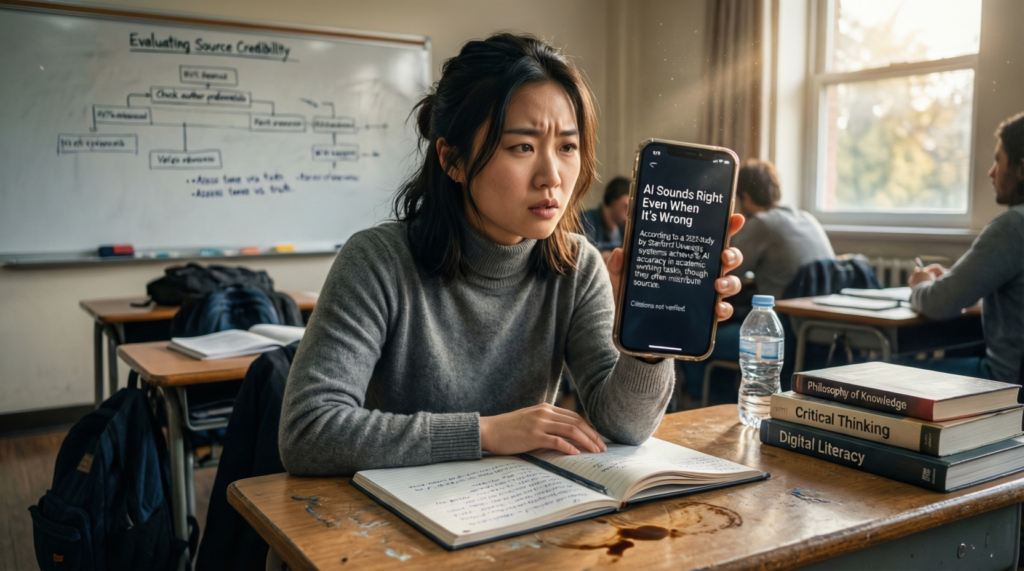
When AI Gets It Wrong
There’s a strange assumption that AI is either totally reliable or completely untrustworthy. The truth sits somewhere in the middle. AI tools are powerful, helpful, and often impressive, but they’re also capable of producing confident nonsense, baked-in bias, and outright inaccuracies.
This is exactly why teachers matter more now, not less. AI’s flaws don’t undermine its usefulness. They highlight the need for human judgment in every step of the learning process.
AI Sounds Right Even When It’s Wrong
One of the most dangerous aspects of AI isn’t the mistake itself—it’s the confidence. Students often assume that fluent writing means accurate writing. They mistake polished tone for truth. That’s a problem. AI can generate citations that don’t exist. It can merge facts incorrectly. It can oversimplify complex issues without indicating it’s doing so.
Students don’t naturally question source credibility. They’ve grown up in a digital environment where answers appear instantly. When AI joined the mix, it amplified the illusion of authority.
This is why they need teachers who understand how these systems fail.
Bias Isn’t a Glitch, It’s a Reflection
AI isn’t neutral. It learns from data created by humans, and humans bring bias into everything. Cultural bias. Linguistic bias. Gender bias. Historical bias. And because AI is pattern-based, it can repeat those biases unless it’s guided or corrected.
A historical summary might erase perspectives that matter.
A reading level tool might misjudge multilingual students.
A career recommendation algorithm might lean toward stereotypical roles.
The danger isn’t the existence of bias. The danger is invisible bias.
Teachers are the ones who help students see it.
Students Need Critical Evaluation Skills More Than Ever
There’s a skill set emerging as one of the most important of this decade: AI literacy. Not how to use AI, but how to evaluate it. How to critique its suggestions. How to verify claims. How to compare versions. How to recognize when something “looks right but feels wrong.”
Students need guided practice in:
- Fact-checking across multiple sources
- Challenging AI reasoning
- Looking for cultural blind spots
- Spotting missing context
- Identifying assumptions baked into outputs
AI isn’t here to give perfect answers. It’s here to provoke better thinking—if teachers structure learning that way.
Teachers Stay in the Loop Because Students Can’t See the Risks Yet
Adults have experience with unreliable systems. Students don’t. They aren’t naturally skeptical. They don’t instinctively push back when something is wrong. And when a tool gives them a polished paragraph or a clean explanation, they often accept it without question.
This is where your role becomes essential. You help them apply judgment. You help them build habits. You help them think about thinking.
You show them that good learners don’t just consume information. They interrogate it.
AI Mistakes Are Teachable Moments, Not Failures
When AI gives a wrong answer, the instinct might be to dismiss the tool. But the real opportunity lies in examining why it was wrong. That process builds stronger metacognition than a correct answer ever could.
A student can investigate:
- What assumptions the AI made
- What information it lacked
- Which part of the reasoning collapsed
- How the error reveals bias or limitations
- How they would correct or improve it
Those investigations build future citizens who don’t just consume AI—they supervise it.
Teachers Aren’t Being Replaced. They’re Becoming Guides in a New Cognitive Landscape.
One of the misconceptions I hear most is the fear that AI will take over teaching. But when AI gets something wrong—and it will—you’re the one who steps in to interpret, contextualize, and correct.
Students can’t do that alone. AI can’t do that at all.
Inaccuracies don’t weaken your role. They make it indispensable.
The Bottom Line
AI will get things wrong. Sometimes subtly. Sometimes spectacularly. But those mistakes aren’t reasons to avoid the tools. They’re reasons to use them with intention.
The classroom of the future won’t be about protecting students from AI. It’ll be about preparing them to evaluate it. And that requires teachers who understand both the power and the pitfalls of these systems.
If you want deeper guidance on balancing AI’s strengths with human oversight, The AI Teaching Revolution explores practical strategies for keeping your judgment at the center of AI-supported learning.